Blood pressure responses to bladder and bowel distension after human spinal cord injury
Blood pressure responses to bladder and bowel distension were characterized in individuals with spinal cord injury using urodynamics, anorectal manometry, and questionnaires.
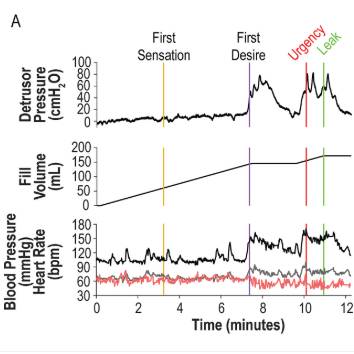
Dataset Overview
Study Purpose: Bladder and bowel distension are primary triggers of autonomic dysreflexia in individuals with cervical and upper-thoracic spinal cord injury, producing sharp, poorly modulated rises in systolic blood pressure. This study was conducted to investigate, in a controlled laboratory setting, the extent and severity of blood pressure responses to bladder and bowel distension in patients with spinal cord injury.
Data Collection: Using urodynamics (cystometry), anorectal manometry, concurrent blood pressure measurement, and questionnaires, blood pressure responses were recorded during bladder filling and anorectal distension and correlated with the distension protocols.
Primary Conclusions: Using urodynamics, anorectal manometry, and blood pressure measurements, we correlate blood pressure responses to bladder and bowel distension.
Curator's Notes
Experimental Design: Cardiovascular responses to visceral distension were assessed in individuals with spinal cord injury. Bladder filling was evaluated by urodynamic cystometry and anorectal function by anorectal manometry, with systolic and diastolic blood pressure monitored throughout, and participants completed questionnaires. Blood pressure responses were then correlated with bladder and bowel distension. Recordings were captured in LabChart (AD Instruments) and Laborie systems, yielding paired instrument outputs per assessment.
Completeness: This dataset is part of a larger study: "Effects of Activity-Dependent Plasticity on Recovery of Bladder and Sexual Function After Human Spinal Cord Injury."
Subjects & Samples: Female (n=21), male (n=35) adult human subjects, ages 18–60 years, were used in this study.
Primary vs derivative data: Primary data are organized by subject, with each subject folder containing anorectal manometry and urodynamics recordings as paired LabChart (.adicht) and Laborie (.txt) files, plus a questionnaire (.pdf). No tissue samples were collected; the dataset comprises physiological recordings and questionnaires organized per subject. There is no derivative data.
Files
1 - 0 of 0 files
About this dataset
Publishing history
Cite this dataset
Tags
References
Is Supplemented by
Medina-Aguinaga, D., Hubscher, C., Wang, S., Manning, T., Johnson, K., Ugiliweneza, B., & Harkema, S. (2026). Blood pressure responses to bladder and bowel distension after human spinal cord injury v1. https://doi.org/10.17504/protocols.io.5qpvoe647l4o/v1
Medina Aguinaga, D., N. Herrity, A., C. Aslan, S., Mesbah, S., Siu, R., Kalvakuri, K., Ugiliweneza, B., Mohamed, A., H. Hubscher, C., & J. Harkema, S. (2023). Spinal cord epidural stimulation to control bladderin spinal cord injury patients v1. https://doi.org/10.17504/protocols.io.8epv5x2w6g1b/v1
Described by
Hubscher, C. H., Wang, S., Manning, T., Johnson, K., Ugiliweneza, B., Medina-Aguiñaga, D., & Harkema, S. J. (2026). Cardiovascular Responses to Bladder and Bowel Distension after Human Spinal Cord Injury. Neurotrauma Reports, 7. https://doi.org/10.1177/2689288x261447881

Copyright © 2026 University of Pennsylvania. All rights reserved.