Bedside quantitative sensory testing in patients with painful distal sensory polyneuropathy
A 5-site cross-sectional study developing QST-based algorithms and sensory biosignatures to predict treatment response in patients with painful distal sensory polyneuropathy
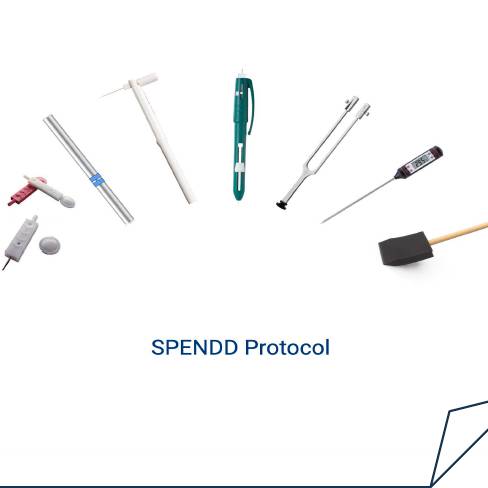
Dataset Overview
Study Purpose: To develop a bedside quantitative sensory testing (QST)-based algorithm for phenotyping patients with peripheral neuropathic pain that can be used to create a sensory biosignature for predicting treatment response, advancing precision pain medicine by matching patient phenotypes to optimal treatment mechanisms.
Data Collection: Quantitative sensory testing data and HEAL common data elements were collected from patients with painful distal sensory polyneuropathy at two study visits approximately one week apart across five clinical sites.
Primary Conclusion: None stated.
Curator's Notes
Experimental Design: This 5-site, cross-sectional study enrolled 203 participants aged 18-80 years with peripheral neuropathic pain. Participants underwent the brief Boston Bedside QST battery and patient-reported outcome assessments at two visits 4-14 days apart. The QST battery assessed sensory thresholds, allodynia, hyperalgesia, and temporal summation. Patient-reported outcomes included pain scales (PEG, BPI, NPSI, PCS), mental health assessments (PHQ-2, GAD-2, PROMIS), and substance use screening (TAPS-1).
Completeness: This dataset is complete.
Subjects & Samples: Female (n=102) and male (n=101) human subjects (ages 20-80 years) with peripheral neuropathic pain were included in this study.
Primary vs derivative data: Primary data folder contains Excel files (.xlsx) organized by assessment type, including demographics, clinical information, patient-reported outcomes, and a demonstration file. A data dictionary (.xlsx) is included in the docs folder. There is no derivative data folder.
Files
1 - 0 of 0 files
About this dataset
Publishing history
Cite this dataset
Tags
References
Is Supplemented by
Koulouris, A. E., Edwards, R. R., Dorado, K., Schreiber, K. L., Lazaridou, A., Rajan, S., White, J., Garcia, J., Gibbons, C., & Freeman, R. (2020). Reliability and Validity of the Boston Bedside Quantitative Sensory Testing Battery for Neuropathic Pain. Pain Medicine, 21(10), 2336–2347. https://doi.org/10.1093/pm/pnaa192

Copyright © 2026 University of Pennsylvania. All rights reserved.