Performance testing of the Fecobionics device
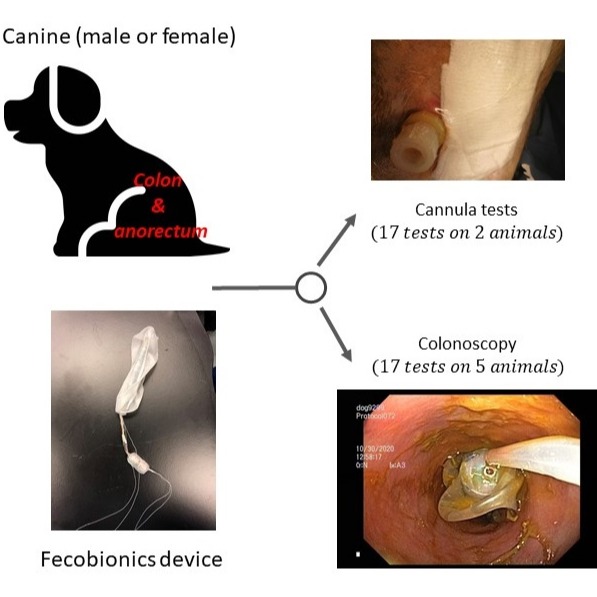
We are developing a novel wireless device named Fecobionics for mapping colonic and anorectal neuromuscular function. The current dataset contains results from the Fecobionics performance study, including both cannula tests and colonoscopic tests.
Dataset Overview
Study Purpose: We are developing a novel wireless device named Fecobionics for mapping colonic and anorectal neuromuscular function. The purpose of this study is to demonstrate the performance of the device in terms of colonic and anorectal measurements in canine.
Data Collection: This dataset contains transmitted Fecobionics data, data recording sheets, fluoroscopic images (show the location of the device), and colonoscopic images (not applicable in cannula tests) from the performance study in the large intestine of the canine.
Primary Conclusion: The animals tolerated the experiments well. Fecobionics successfully measures parameters (pressure, orientation, bending angle, cross-sectional area, etc.) during colon movement and defecation.
Curator's Notes
Experimental Design: The experiments were approved by the Institutional Animal Care and Use Committee (protocol Calmi2-072). All experimental animals were anesthetized and subjected to a laparotomy, a cannula was implanted into the proximal of the colon (4-5 cm to the cecum). The external end of the cannula was screwed by a cap, which is able to open for device insertion. After 10-14 days of recovery, the Fecobionics device was inserted through the cannula for testing and X-ray fluoroscopy was performed frequently to locate the device. Data was recorded for analysis.
Completeness: This dataset is a part of the larger study: "Safety Study of Wireless Fecobionics Device"
Subjects & Samples: Three male Mongrel dogs, age 7-12 months were used in the study.
Primary vs derivative data: Primary data collected from the study is organized in folders denoted with the subject ID. Each folder contains transmitted Fecobionics data, data recording sheets, fluoroscopic images, and colonoscopic images for each test performed. There is no derivative data folder.
Files
1 - 0 of 0 files
About this dataset
Publishing history
Cite this dataset
Tags
References
Is Supplemented by
Wang, Y., & Gregersen, H. (2020). Performance Study of Wireless Fecobionics Device in Canine v1. https://doi.org/10.17504/protocols.io.bpzfmp3n
Described by
Gregersen, H., Wang, Y., Guo, X., Field, F., Nelson, M., Combs, W., Wang, M., & Kassab, G. (2021). Simulated Colonic Feces Reveals Novel Contraction Patterns. Gastroenterology, 160(3), 660–662. https://doi.org/10.1053/j.gastro.2020.09.055

Copyright © 2026 University of Pennsylvania. All rights reserved.